Overview
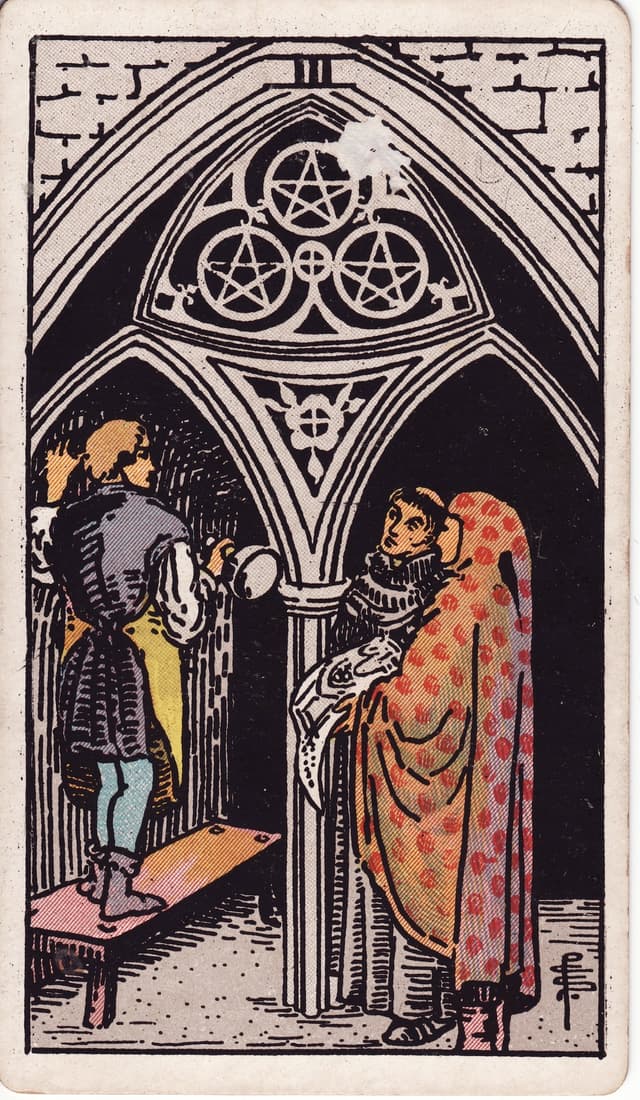
A skilled craftsman works on a cathedral wall while two others review the plans. The Three of Pentacles celebrates the point where talent meets teamwork: skilled collaboration, learning from masters, and the early stages of building something excellent.
Symbolism
A sculptor works on a stone carving inside a monastery or cathedral. Two robed figures, one holding an architectural plan, observe and consult with him. Three pentacles are visible in the carved arch above. The setting is sacred architecture, representing work done with purpose and devotion. The interaction between the craftsman and the planners shows that great work requires both skill and vision, execution and design. Nobody here is working alone.
Upright Meaning
In love, the Three of Pentacles signals a relationship where both people actively build something together. Shared projects, home improvement, financial planning as a team, or the deliberate work of making a relationship better all fit. Love here is practical and collaborative. In career, this is one of the best cards for professional development. Your skills are being recognized and refined. Teamwork produces excellent results, and mentorship or formal training pays off. Quality work, not shortcuts, leads to advancement. Spiritually, the Three of Pentacles reminds you that spiritual growth benefits from community and mentorship. Learning from others, contributing your skills to a group endeavor, and treating your practice with the seriousness of a master craftsman all serve you.
Reversed Meaning
Reversed, the Three of Pentacles signals dysfunctional teamwork, lack of respect for expertise, or sloppy workmanship. Group projects fall apart due to poor communication or conflicting visions. Your skills may be undervalued, or you might be cutting corners on quality. Lone-wolf behavior undermines what could be collaborative success.
When You Draw This Card
Invest in your craft and your collaborators. The best work happens when skilled people share a vision and commit to executing it well.
Grounded in A.E. Waite's Pictorial Key to the Tarot (1911, public domain), with modern interpretation.